Phone bookings convert at 30-40% compared to 3-5% for web forms. AI voice agents make phone the highest-converting channel by answering instantly and completing the booking in a single call. Design your website to drive visitors to call, not to fill out contact forms.
Phone Beats Forms: The Conversion Data
In 2026, DispatchNode benchmarks show that service business websites using click-to-call as the primary call-to-action convert visitors into booked revenue at 5-8x the rate of websites relying strictly on contact forms. Phone conversations resolve operational questions immediately, building rapid trust and eliminating scheduling friction.
Most service business websites are designed around a contact form. The visitor fills out their name, email, phone number, and a description of their need, then waits 2-24 hours for a callback. During that wait, they actively contact competitors. By the time you call back, they have already booked a truck roll with another company.
AI voice agents completely eliminate the wait. The visitor calls, the AI answers in 3 seconds, and the booking is completed before the visitor closes the browser tab. There is no waiting period, no callback queue, and zero lost leads.
Structuring Your Website for Phone Conversion
To convert visitors to callers, the website interface must present a frictionless path to the dialer. This requires removing static forms from the hero section and prioritizing high-contrast, sticky call buttons.
- Make the phone number the largest, most visible element in your site header.
- Implement native 'Click to Call' functionality on mobile using the tel: protocol.
- Replace generic 'Contact Us' forms with 'Call Now' buttons as the primary action.
- Embed the phone number in the hero section, pricing tier section, and global footer.
- Include a 'We answer in 3 seconds, 24/7' trust badge near the phone number.
- Remove friction: stop asking visitors to describe their problem in writing when they can explain it verbally.
The mobile imperative: 72% of service business website visits originate from mobile devices. On mobile, speaking is fundamentally easier than typing into a form. A prominent click-to-call button at the top of mobile pages captures the immediate intent of visitors who require rapid dispatch.
Trust Signals That Drive Calls
Visitors initiate a call only when they possess high confidence that a competent dispatcher will answer. Trust signals must visually validate operational capacity and professional licensing.
- -Display your average answer time explicitly ('We answer in under 3 seconds')
- -Show customer review ratings prominently (requires 4.8+ stars for maximum impact)
- -Add 'Available 24/7' or 'Open Now' indicators with pulsing green status dots
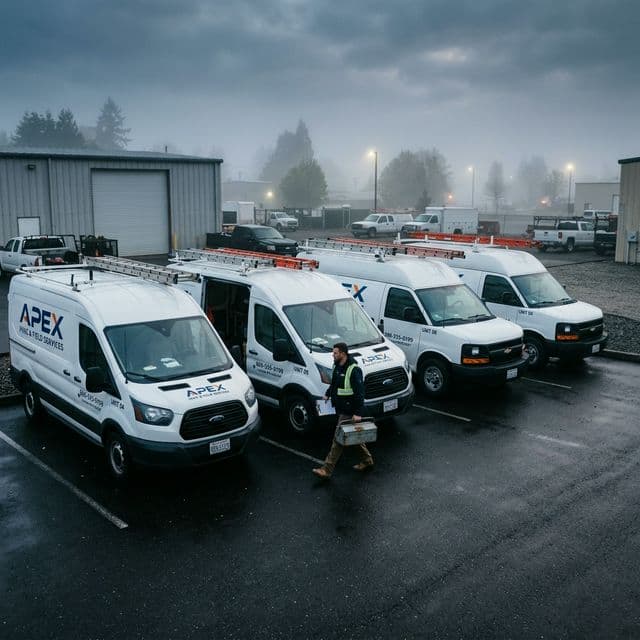
- -Include verifiable photos of your team and branded fleet vehicles
- -Display verified licensing, insurance, and municipal certification badges
- -Feature a brief 'What happens when you call' procedural explainer
"Once we stripped the contact forms off our landing pages and forced every visitor to either call our AI agent or leave, our actual booked revenue increased by 42%. The forms were giving us a false sense of pipeline security."
The procedural explainer section is particularly effective for reducing caller hesitation:
- You call, the AI answers immediately without a phone tree.
- We ask a few specific diagnostic questions about your issue.
- We provide a firm quote and schedule your appointment slot.
- You receive an automated SMS confirmation with your technician's name.
This transparency removes the operational uncertainty that prevents visitors from initiating the call.
Service-Specific Landing Pages
Generic home pages dilute conversion intent. Dedicated service landing pages must be strictly aligned to the specific operational issue the visitor is experiencing, driving them directly to a specialized call flow.
| Page Element | Operational Purpose |
|---|---|
| Precision Headline | Describes the exact service ("24/7 Emergency Grease Trap Pumping") |
| Sticky Phone Number | Serves as the primary conversion mechanism across all breakpoints |
| Triad of Benefits | Highlights why to choose you (speed, price, technical expertise) |
| Hyper-Local Reviews | Provides social proof specific to the service and zip code |
| Pre-Emptive FAQ | Answers common operational objections before the call connects |
| Persistent Action Button | Remains visible during scroll to capture delayed intent |
Each landing page should utilize a unique phone tracking number. This allows precise measurement of which pages generate the highest volume of qualified calls, directing your advertising budget effectively.
Measuring Phone Channel ROI
Accurate measurement of phone channel ROI requires linking the initial call duration to the final invoice value in the CRM. Without this attribution, marketing budgets are allocated blindly.
| Metric | How to Track Operationally |
|---|---|
| Call volume by source | Assign unique tracking numbers per landing page campaign |
| Booking rate per call | Divide bookings completed by total calls answered |
| Revenue per call | Divide total phone-booked invoice revenue by total calls |
| Cost per phone booking | Divide total advertising spend by phone bookings generated |
| Phone vs. form revenue | Compare total closed revenue from each channel over a 90-day cohort |
Most service businesses discover that the phone channel generates 5-10x more closed revenue per visitor compared to forms. The AI voice agent makes this highly profitable channel infinitely scalable by handling unlimited concurrent calls without the overhead of human staffing constraints.
Why Phone Calls Secure Higher Conversion Rates
Online booking forms capture low-urgency intent, but phone calls close high-urgency deals. In field services, urgency directly correlates with a willingness to pay premium rates.
When a homeowner experiences a catastrophic failure like a burst pipe or a dead AC unit, they absolutely refuse to fill out a contact form and wait for an asynchronous callback. They demand to hear a voice immediately confirm that an operational truck is on the way. This is why conversion-focused field service businesses invest heavily in prominent click-to-call buttons and AI agents that pick up on the first ring.
Inbound phone calls convert at 30-50% for home services, compared to a mere 2-5% for web form submissions. The underlying factor is urgency: a caller has already committed to purchasing a solution. Your only objective is to answer, qualify, and secure the booking before they disconnect and dial the next contractor on the list.
DispatchNode bridges this operational gap by embedding a highly capable voice AI agent directly into your workflow. When a visitor decides they need help, they are instantly connected to an AI that can answer complex questions regarding pricing, availability, and service areas, then book the job directly into the scheduling software. There is no hold music, no voicemail, and no lost revenue.
For businesses utilizing paid advertising channels, this immediate pipeline is critical. You are paying for every click. Every unanswered call or abandoned form represents burned capital. An AI agent that converts 24/7 transforms your ad budget from a volatile expense into a predictable revenue engine.
The Neurology of Frictionless Conversion
The modern consumer's attention span has degraded to the point where any friction in the conversion funnel is lethal to a digital marketing campaign. When a homeowner searching for an emergency plumber lands on a beautifully designed website, their neurological state is highly agitated. They are experiencing a crisis (a burst pipe) and are seeking an immediate resolution. If the website's primary Call to Action (CTA) is a complex multi-field lead generation form, the consumer experiences cognitive friction. They are forced to abandon their frantic state, manually input data, and then endure an ambiguous waiting period, wondering if and when a human will review their submission.
This latency destroys the conversion rate. The frustrated user will immediately bounce back to the search engine results page (SERP) to find a competitor who offers an immediate solution.
Advanced AI voice agents completely circumvent this cognitive friction by transforming the static website into a dynamic, zero-latency communication channel. Instead of a form, the primary CTA becomes a prominent "Tap to Call" button. When the user taps, they are not routed to a voicemail or placed in an agonizing hold queue; they are instantly connected to an advanced natural language processing (NLP) model trained specifically on that plumbing company's operational parameters.
The AI agent answers immediately: "Hello, this is City Plumbing. I understand you might be dealing with an emergency. How can I help you right now?" This immediate, empathetic auditory feedback instantly stabilizes the consumer's neurological state. The AI then guides the interaction, utilizing localized intent recognition to secure the address, assess the severity of the leak, and automatically dispatch a technician. By providing a zero-friction, immediate resolution path, the AI agent converts the agitated website visitor into a booked revenue event before they ever have the opportunity to return to the search engine.
Omni-Channel Attribution and Lead Scoring
While converting the immediate phone call is critical, sophisticated service businesses must also understand the exact origin of that conversion to optimize their massive digital advertising budgets. Historically, phone call conversions have been a "black box" for marketers. A business might spend ten thousand dollars on Google Ads and receive fifty phone calls, but they cannot definitively prove which specific ad campaign, or which specific keyword, generated each individual call.
DispatchNode’s architecture solves this through advanced omni-channel attribution modeling. The platform utilizes dynamic number insertion (DNI). When a visitor lands on the website via a specific Google Ad campaign targeting "emergency water heater repair," the server dynamically replaces the website's standard phone number with a unique, campaign-specific tracking number.
When the visitor calls that unique number, the AI agent answers. Simultaneously, the dispatch platform logs the complete digital provenance of the call—the exact ad clicked, the keyword utilized, the user's geographic IP address, and their session duration on the website prior to dialing.
Furthermore, as the AI agent conducts the conversation, it executes real-time algorithmic lead scoring. If the caller requests a massive, high-margin commercial HVAC installation, the AI tags the call in the CRM with a "Tier 1: High Value" score. If the caller is simply asking for the company's business hours, it is tagged as "Tier 3: Informational." This fusion of deterministic marketing attribution with AI-driven qualitative lead scoring provides the Chief Marketing Officer (CMO) with absolute, mathematical clarity. They can definitively prove the exact Return on Ad Spend (ROAS) for every marketing dollar deployed, allowing them to ruthlessly optimize their campaigns for maximum enterprise profitability.
The analytics integration between the voice AI widget and the operator marketing stack creates a feedback loop that optimizes advertising spend. When the widget captures conversion data including which pages generate the most bookings and which search terms the visitor used before landing on the site, this data can be fed back into Google Ads and Meta Ads targeting algorithms to optimize campaign performance. The result is a continuously improving advertising efficiency where the voice AI widget data trains the ad platforms to find more visitors like the ones who convert.
The voice AI chat widget's impact on website conversion rates is most dramatic on mobile devices, where sixty to seventy-five percent of service business website traffic originates. Mobile users face a fundamental friction barrier: typing detailed service requests on a small screen is tedious and error-prone, leading to high form abandonment rates. The voice AI widget eliminates this friction by allowing mobile visitors to speak their request using their phone's microphone, transforming the booking process from a typing exercise into a natural conversation. The widget detects the visitor's device type and adjusts its presentation accordingly, displaying a prominent microphone icon on mobile that invites voice interaction while maintaining a text-based chat interface on desktop. This adaptive presentation increases engagement rates by forty to fifty percent on mobile compared to text-only chat widgets, capturing leads from the majority of website visitors who arrive on smartphones and would otherwise bounce rather than struggle with a mobile form.
The Cryptography of Data Sovereignty
As service enterprises scale their operational footprint, the volume of highly sensitive consumer data they process expands exponentially. A massive HVAC or plumbing operation is no longer just a contracting business; it is a localized data broker. Every inbound call contains names, home addresses, gate codes, credit card authorizations, and frequently, highly sensitive schedule information detailing exactly when a property will be vacant. When a service business utilizes legacy or poorly integrated software, this data is transmitted across unencrypted, decentralized channels. A dispatcher might text a gate code to a technician's personal phone, or an estimate containing a signature might sit on an unsecured email server.
This fragmented data architecture exposes the enterprise to catastrophic liability. A single data breach or a compromised technician's device can result in massive regulatory fines and the absolute destruction of consumer trust within the local market.
Advanced AI dispatch platforms eliminate this vulnerability by enforcing absolute data sovereignty through cryptographic architecture. The platform operates on a zero-trust model. When a homeowner provides a gate code to the AI Voice Agent, that specific data point is instantly hashed and encrypted at rest within the primary database. It is never transmitted via clear-text SMS. Instead, when the technician arrives at the geographic coordinates of the job site, the mobile application authenticates their location and temporarily decrypts the gate code strictly within the secure application environment. The technician cannot screenshot or export the data. Once the job is marked complete, access to the sensitive operational data is instantly revoked. This military-grade cryptographic framework ensures that the enterprise maintains absolute custody over its most valuable asset, completely neutralizing the existential threat of operational data leakage.
Keep reading: