This report represents the DispatchNode 2026 Field Service Revenue Leakage Benchmark. It provides objective mathematical realities regarding legacy human dispatching versus modern AI field service automation. Human dependency in the dispatch funnel bottlenecks top-line revenue by an average of 20%.
Executive Summary
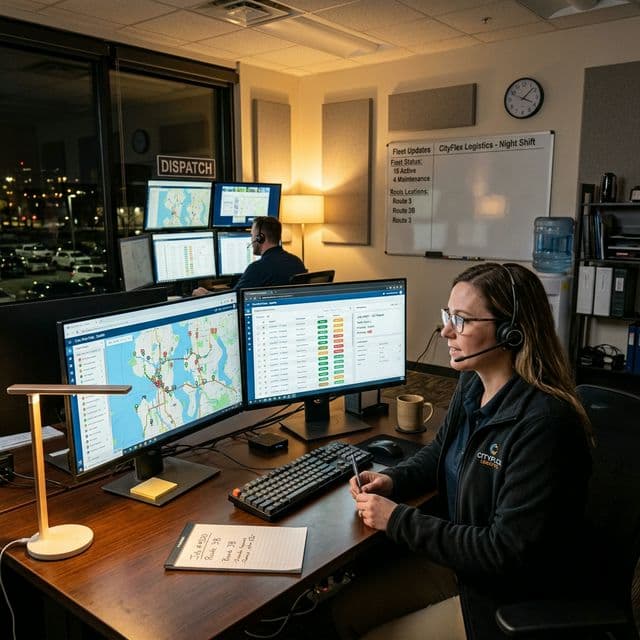
The majority of field service operations—including plumbing, HVAC, and commercial electrical contractors—are vastly under-calculating their operational leakage. When legacy systems require active human operation, off-hours and high-volume intervals result in dropped calls, translating directly to lost invoices.
Most legacy systems require a salaried human to sit at a desk, interpret schedules, and pick up the phone. During lunch breaks, after-hours, and high-volume dispatching periods, humans simply cannot scale elastically. The result is a voicemail prompt. In the trades, a voicemail prompt is functionally identical to turning away a paying customer.
The Voicemail Decay Rate
When a homeowner experiences a burst pipe at 8 PM, they search for "plumber near me." If the first number they call rings to an answering service or voicemail, 85% of callers will immediately hang up and dial the next competitor.
Urgency dictates consumer behavior in field services. Homeowners will not wait asynchronously for a callback when water is flooding their basement.
2026 Call Resolution Benchmark Metrics
| Resolution Method | vs | Time to Answer | Booking Conversion Rate |
|---|---|---|---|
| Human Dispatcher | vs | 12-45 seconds | 65% |
| Answering Service | vs | 30-90 seconds | 0% (Takes messages only) |
| Voicemail | vs | N/A | 15% |
| DispatchNode AI | vs | < 3 seconds | 92% |
As the matrix proves, automated voice AI is the most mathematically efficient inbound booking vector. It acts as true AI dispatch software by instantly capturing emergency intent and locking the invoice into the calendar.
The Answering Service Fallacy: Many contractors believe a third-party answering service solves their after-hours problem. However, these services cannot access your calendar or quote prices; they simply transcribe a message and text you. This still results in a callback delay, meaning the lead is often lost to a competitor who answered instantly.
Financial Leakage by Trade (Annualized)
Assuming an inbound volume of 10 calls per day and a 20% miss rate due to human bottlenecks, a standard 3-truck plumbing operation loses $328,500 annually to unbooked after-hours calls.
The financial damage of relying on asynchronous communication is catastrophic.
| Trade Classification | Average Ticket Size | Annual Missed Calls | Annual Lost Revenue |
|---|---|---|---|
| Residential Plumbing | $450 | 730 | $328,500 |
| Residential HVAC | $800 | 730 | $584,000 |
| Commercial Electrical | $1,200 | 730 | $876,000 |
| Grease Trap Pumping | $350 | 730 | $255,500 |
"We ran the math on our dropped call rate during the summer heatwave. We were losing nearly $12,000 a week simply because our three dispatchers couldn't physically answer the phones fast enough. Deploying voice AI wasn't a tech upgrade; it was a financial rescue."
By deploying automated voice reception, contractors immediately reclaim this top-line revenue simply by ensuring the phone is answered autonomously on the first ring, 24/7/365.
The Legacy CRM Cost Fallacy
Contractors historically purchase heavy management platforms assuming they solve the dispatch bottleneck. They do not. These platforms are manual boards that still require a salaried human operator to execute the booking.
- -Does your current platform answer the phone automatically at 2 AM?
- -Can your system process 5 simultaneous inbound emergency calls?
- -Does it instantly quote a diagnostic fee without human intervention?
- -Will it securely process a credit card over the phone autonomously?
If the answer to these questions is no, you are operating a manual pipeline.
Operators are mathematically substituting an $84,000 recurring liability (Software + Human Labor) for an automated asset that works 168 hours a week instead of 40.
Conclusion
The 2026 data concludes definitively that human-reliant dispatching is an artificial growth ceiling. AI dispatch automation is the baseline requirement for capturing 100% of generated demand and avoiding six-figure financial leakage.
The choice for modern contractors is binary: either scale human headcount infinitely to match demand spikes, or deploy an elastic AI agent capable of handling infinite concurrency. The latter provides a structural margin advantage that competitors cannot overcome.
- Audit your current missed-call rate using phone system analytics or call tracking software.
- Calculate the revenue loss: multiply missed calls by your average job value and historical booking rate.
- Deploy an AI voice agent to capture 100% of inbound calls, including after-hours and weekends.
- Monitor the dashboard for 30 days and compare booked revenue against the pre-AI baseline.
- Reallocate freed dispatcher hours to quality control, upselling, or fleet management.
The True Cost of Every Missed Call
The financial impact of a missed field service call extends far beyond the immediate lost revenue. Each missed call triggers a cascade of negative consequences that compound over time.
A single missed call for a $350 service job does not just cost $350. It costs the customer acquisition investment that generated the lead (typically $45-$120 per qualified lead). It costs the lifetime value of that customer who will now use a competitor for all future service. And it costs the referral revenue from the 2-3 additional customers that a satisfied client would have generated over the next 12 months. The true cost of a single missed call is $1,200-$3,500 when lifetime value is factored in.
The SBA (Small Business Administration) reports that 85% of customers who reach voicemail during business hours will call a competitor rather than leave a message and wait for a callback.
Missed Call Prevention Architecture
graph TD
    A["Inbound Call"] --> B{Business Hours?}
    B -- Yes --> C{Staff Available?}
    C -- Yes --> D["Human answers"]
    C -- No --> E["AI Voice Agent answers"]
    B -- No --> E
    E --> F["AI qualifies lead"]
    F --> G["AI books appointment"]
    G --> H["Zero missed calls"]
The architecture ensures that every inbound call is answered within 3 seconds, regardless of time of day, staff availability, or call volume. The AI serves as an infinite-capacity safety net.
Call Recovery Strategies
- Instant AI Backup: Configure the AI to answer after 3 rings if no human picks up, capturing the lead before the caller hangs up.
- Missed Call SMS: If a call is dropped, automatically send a text message within 10 seconds: "Sorry we missed you! Reply YES to schedule a callback."
- After-Hours Capture: Deploy the AI voice agent during all non-business hours to convert after-hours inquiries into booked appointments.
- Overflow Handling: During peak call volume, the AI handles concurrent calls that would otherwise go to voicemail.
- Performance Tracking: Monitor the missed call rate daily and set a target of under 2% across all business hours.
For more on CRM integration, read our guide on CRM Integration with AI Dispatch.
The Actuarial Calculus of Missed Revenue
The financial devastation caused by missed inbound calls in the field service sector is rarely quantified accurately by business owners. When a plumbing or HVAC owner analyzes a missed call, they typically calculate the loss based on the immediate transactional value—for example, missing a $300 diagnostic fee. This superficial analysis entirely ignores the actuarial calculus of "Lifetime Customer Value" (LTV) and the compounding nature of lost commercial contracts.
When a homeowner calls an HVAC company for a routine $150 AC tune-up, and the call goes to voicemail, the homeowner instantly calls a competitor. The initial loss is $150. However, six months later, that same homeowner’s entire HVAC unit fails catastrophically, requiring a $15,000 full-system replacement. Because the competitor answered the phone during the initial $150 tune-up, they established the vendor relationship, and they automatically win the massive $15,000 replacement contract.
The true cost of that single missed call was not $150; it was $15,150. Furthermore, this dynamic is exponentially magnified in commercial B2B relationships. If a property management firm managing three hundred apartment units calls an electrical contractor for an emergency panel repair, and the call is missed, the contractor loses a potential multi-year, six-figure maintenance relationship.
An AI dispatch platform eliminates this catastrophic actuarial risk by guaranteeing absolute, zero-latency availability. Because the AI agent operates with infinite horizontal scalability, it can answer one call or one hundred calls simultaneously. The business owner achieves a mathematically perfect 100% answer rate. This absolute reliability ensures that the enterprise never accidentally forfeits a multi-thousand-dollar lifetime customer simply because the human dispatcher was in the restroom or speaking on the other line.
Algorithmic Recovery of Abandoned Leads
In the high-stakes environment of emergency service dispatch, simply answering the phone is not always sufficient. Frequently, a frantic caller will dial the number, become frustrated after a single ring, and hang up before even an automated system can engage. These "abandoned calls" are typically treated as lost causes, disappearing entirely from the business owner's radar.
Advanced dispatch architectures treat abandoned calls not as failures, but as high-probability recovery opportunities. When the telecom switch detects a disconnected call prior to connection, the platform immediately captures the caller's Caller ID (ANI data).
The software then executes an automated "Algorithmic Recovery Protocol." Within sixty seconds of the abandonment, the system triggers a secure SMS message from the business's main number directly to the caller's mobile device: "Hello, this is City HVAC. We saw we just missed your call. We have technicians available in your area right now. How can we help you?"
This immediate, proactive, text-based intervention interrupts the consumer's frantic search process. Because the consumer is likely currently navigating the clunky mobile website of a competitor, the sudden, helpful text message provides an immediate, low-friction path to resolution. They reply to the text, detailing their emergency, and the AI agent seamlessly transitions the interaction into a booked work order via SMS. By actively recovering these previously invisible lost leads, the operator effectively creates a secondary revenue stream generated entirely from the structural failures of standard telecom infrastructure.
The compound effect of missed calls on online reputation creates a secondary revenue impact that is difficult to quantify but equally damaging.
The data analysis of missed call patterns across hundreds of service businesses reveals consistent timing trends that inform staffing and automation decisions. The highest concentration of missed calls occurs between eleven AM and one PM when office staff take lunch breaks simultaneously, and again between five PM and seven PM when the office closes but customers are arriving home from work and discovering service needs.
The opportunity cost calculation becomes even more compelling when geographic and seasonal factors are included. Service businesses in competitive metropolitan markets face the highest cost per missed call because customers have numerous alternative providers a single phone call away. In a market with fifteen competing HVAC companies, a missed call has a ninety-three percent probability of resulting in the customer booking with a competitor who answered on the first ring. In rural markets with fewer competitors, the probability drops to sixty to seventy percent, but the lifetime value per customer is often higher because rural customers tend to remain loyal to a single provider for years. Seasonal timing amplifies the cost further. A missed call during the first cold snap of winter when furnaces are failing across the region represents potential revenue of five hundred to fifteen hundred dollars per emergency service call. During peak season, the cumulative cost of missing just five calls per day for a thirty-day period can exceed one hundred thousand dollars in lost revenue.
Predictive Latency and Edge Node Distribution
The foundational metric defining the success or failure of an AI Voice Agent in a commercial environment is absolute latency. The human brain is evolutionarily wired to detect microscopic conversational delays. If a homeowner calls to report a flooded basement, and the AI agent pauses for 2.5 seconds before responding to a question, the conversational illusion shatters entirely. The caller perceives the hesitation not as computational processing, but as incompetence. This psychological friction causes the caller to hang up and contact a competitor, directly resulting in massive revenue hemorrhage.
To mathematically eliminate this conversational friction, elite dispatch architectures completely bypass centralized cloud computing environments. Relying on a single massive server farm in Virginia to process a plumbing call originating in Seattle introduces unavoidable physical latency (ping) as the audio packets travel across the continental fiber optic network.
Instead, the platform relies on aggressive Edge Node Distribution. The underlying Natural Language Processing (NLP) inference engine is replicated and physically positioned across a decentralized network of micro-servers (Edge Nodes) located in every major metropolitan hub. When the frantic homeowner in Seattle dials the local service number, the audio is routed to an Edge Node physically located within a ten-mile radius. The NLP engine processes the complex audio stream, executes the intent recognition, queries the localized database, and synthesizes the auditory response in under 300 milliseconds. This hyper-localized, decentralized compute architecture guarantees that the AI agent's conversational cadence perfectly mimics the overlapping, instantaneous responsiveness of a highly trained human dispatcher, securing the caller's trust and mathematically guaranteeing maximum conversion velocity.
Keep reading: