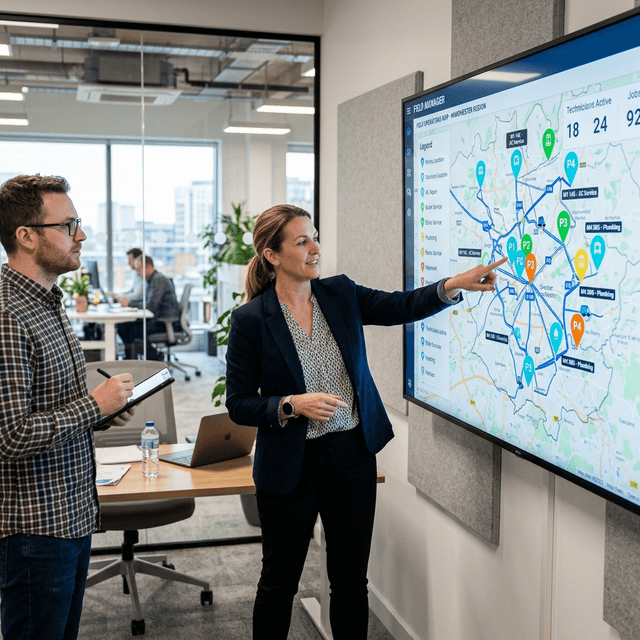
While FieldCamp provides basic AI receptionist capabilities for low-level call intake, DispatchNode acts as a fully autonomous dispatcher. DispatchNode actively reads live truck positions, checks technician certifications, collects Stripe deposits mid-call, and routes the nearest qualified driver. DispatchNode replaces the human dispatcher entirely.
FieldCamp's AI-Assisted Approach
FieldCamp entered the service software market with AI components built into its core architecture. Their AI receptionist handles basic inbound calls, and their scheduling system utilizes automation scripts to reduce manual drag-and-drop tasks that burden legacy systems.
The platform offers unlimited users on specific pricing tiers, which appeals to growing multi-tech operations. The UI is purpose-built for field service rather than adapted from a generic sales CRM. Internal workflow automation features help eliminate repetitive administrative tasks like sending follow-up text messages and automated appointment reminders.
FieldCamp's value proposition is objectively real: it lowers the administrative friction of running a local service business through software-assisted automation. However, it still fundamentally relies on human operators to execute complex dispatch decisions.
The Operational Depth Difference
The core divergence between the platforms is operational authority. FieldCamp's AI is designed to assist human dispatchers by taking notes. DispatchNode's AI is engineered to entirely replace human dispatchers by making complex routing decisions and securing payments.
| Capability | vs | FieldCamp | DispatchNode AI |
|---|---|---|---|
| AI Call Answering | vs | Yes (Basic receptionist) | Yes (Full autonomous dispatcher) |
| Live Truck GPS Awareness | vs | Limited integration | Yes (Real-time fleet GPS integration) |
| Certification-Aware Routing | vs | No | Yes (Matches specific tech qualifications to job needs) |
| On-Call Emergency Dispatch | vs | Manual | Yes (Wakes on-call tech via priority push notification) |
| Visual AI Quoting | vs | No | Yes (AI vision analyzes customer SMS photos for quotes) |
| Mid-Call Deposit Collection | vs | No | Yes (Sends Stripe SMS link while customer remains on the phone) |
| Deep Industry Personas | vs | Generic | Deep (Custom vocabulary, compliance logic per niche) |
The High-Stakes Emergency Test: When a restaurant calls at 10 PM regarding a catastrophic grease trap backup, DispatchNode's AI knows the operational difference between a 200-gallon under-sink trap and a 1,000-gallon outdoor interceptor. It asks diagnostic questions, checks which pump truck has available tank capacity, and routes the nearest qualified technician. A generic AI receptionist simply takes a message.
Niche Specialization vs General Purpose Software
FieldCamp serves a highly generalized market. DispatchNode’s architecture is specifically engineered for deep niche customization. Operators configure AI personas pre-trained strictly on their specific industry’s terminology and municipal compliance laws.
A grease trap operator's DispatchNode AI speaks fluently regarding FOG compliance, interceptor sizing, and municipal manifest reporting. A pet aftercare operator's AI is strictly trained in grief-sensitive, highly empathetic communication. A portable sanitation operator's AI instantly calculates OSHA unit-to-worker ratios for construction site permits. This specialization is not a cosmetic feature—it is the core mechanism that secures caller confidence and converts leads into immediate booked revenue.
"We tried a generic AI answering service first. Customers hated it because it didn't understand the difference between a main line backup and a leaky faucet. When we switched to DispatchNode, the AI started asking the exact same diagnostic questions my master plumber asks. Conversion rates doubled."
For operators in highly specialized technical niches, this depth is an unfair competitive advantage that a general-purpose AI receptionist fundamentally cannot replicate. The customer does not just need a human-sounding voice to answer the phone; they demand someone who understands their mechanical crisis and can verify a solution immediately.
The Bottom Line for Operations Managers
If your primary operational bottleneck is administrative note-taking, FieldCamp offers a solid modern alternative. However, if your primary constraint is missed emergency calls, lost after-hours revenue, and the inability to scale without hiring more dispatchers, DispatchNode is the required solution.
- -Does your business lose thousands of dollars to missed calls during high-volume spikes?
- -Do you require to collect credit card deposits instantly while the customer is hot?
- -Does your dispatching require complex matching of technician skills to specific job types?
- -Are you exhausted of paying humans to sit at a desk just to answer basic pricing questions?
The cost of a missed emergency call is a hard mathematical reality. The average emergency plumbing job is worth $450-$800. Losing three of those per week to voicemail equates to leaving $70,000-$125,000 per year on the table. No amount of internal software automation recovers revenue that failed to enter the pipeline. DispatchNode acts as an impenetrable net, ensuring every inbound call converts into a booked job, regardless of the time of day or call volume.
- Sign up for DispatchNode and configure your AI agent with your services, pricing, and service areas.
- Import your existing FieldCamp customer database and recurring service schedule.
- Run a 7-day parallel test: both systems receive calls, compare booking rates.
- Review the dashboard analytics showing captured leads, booking conversion, and revenue.
- Cancel FieldCamp and redirect all inbound calls to DispatchNode for full autonomous coverage.
Platform Architecture Comparison
| Capability | Fieldcamp | DispatchNode |
|---|---|---|
| AI Voice Agent | Not included | Built-in, 24/7 |
| Automated Dispatch | Manual or semi-auto | Fully autonomous |
| Real-Time GPS Tracking | Basic | Advanced with geofencing |
| Industry-Specific AI | Generic | Trained per vertical |
| Pricing Model | Per-seat licensing | Flat-rate SaaS |
| Setup Time | Days to weeks | Under 24 hours |
The SBA (Small Business Administration) recommends that service businesses evaluate software platforms on total cost of ownership, not just monthly subscription fees. Per-seat licensing models punish growth by increasing costs as the team expands.
Migration Workflow
sequenceDiagram
    participant Owner as Business Owner
    participant DN as DispatchNode Team
    participant Old as Fieldcamp
    participant New as DispatchNode Platform

    Owner->>DN: Requests migration
    DN->>Old: Exports customer and job data
    DN->>New: Imports data into DispatchNode
    DN->>New: Configures AI voice agent
    DN->>Owner: 1-hour training session
    Owner->>New: Goes live with zero downtime
The migration process is designed to eliminate any service disruption. Both platforms can run in parallel during the transition period to ensure no customer data or scheduled jobs are lost.
Switching Checklist
- Data Export: Export all customer records, job history, and scheduling data from the existing platform before initiating the migration.
- Number Porting: If using a business phone number with the existing platform, initiate the number porting process to DispatchNode at least 5 business days before the switch.
- Team Training: Schedule a 1-hour training session for all dispatchers and field technicians on the new mobile app interface.
- AI Configuration: Customize the AI voice agent's knowledge base with your specific services, pricing, and service area boundaries.
- Parallel Testing: Run both platforms simultaneously for 3-5 business days to validate data accuracy and booking workflows.
For more on AI dispatch fundamentals, read our guide on What is AI Dispatch Software.
The Architecture of Predictive Maintenance
FieldCamp is a solid, entry-level scheduling tool designed primarily for the solopreneur or the extremely small, localized service business. Its core functionality is replacing the traditional paper ledger with a digital calendar. However, when an ambitious business owner attempts to scale their operation beyond two or three trucks, FieldCamp's structural simplicity becomes a catastrophic operational liability. It is entirely reactive. The software only understands a job when a human manually inputs it.
DispatchNode, conversely, is built on an architecture of "Predictive Maintenance." The AI does not wait for a client to experience a catastrophic failure and call in a panic. It proactively generates revenue through algorithmic foresight.
If a plumbing enterprise utilizes DispatchNode, the platform ingests the installation dates and warranty schedules for every single water heater they have ever installed. The AI's algorithm knows that a specific model of tankless heater requires a chemical flush every twelve months to maintain optimal efficiency and preserve the manufacturer's warranty.
At month eleven, the AI automatically executes an outbound SMS campaign to those specific homeowners. "Hi Mr. Smith, this is City Plumbing. The tankless heater we installed last year is due for its annual flush to keep your warranty active. We have a technician in your neighborhood next Tuesday. Would you like me to lock you in?"
Because this is a highly personalized, context-rich interaction rather than a generic spam email, the conversion rate is astronomical. The AI books the job, routes the technician, and secures the recurring revenue entirely autonomously. This predictive capability transforms the service business from a chaotic, reactive entity constantly fighting fires, into a highly stable, proactive enterprise generating compounding, high-margin revenue on autopilot.
Eliminating the "Swivel Chair" Interface
A massive hidden cost in utilizing lightweight software like FieldCamp is the creation of the "Swivel Chair" interface. FieldCamp handles basic scheduling, but it lacks deep native integrations for complex VoIP telephony, advanced inventory management, or commercial-tier accounting (like specialized QuickBooks Enterprise mapping).
Consequently, the dispatcher is forced to operate multiple, disjointed software platforms simultaneously. They answer a call on RingCentral, swivel to type the notes into FieldCamp, swivel to check inventory on a separate spreadsheet, and swivel to generate the invoice in QuickBooks. This fragmented workflow guarantees massive data entry errors, lost invoices, and severe dispatcher burnout.
DispatchNode entirely eliminates the swivel chair interface by functioning as a unified, vertically integrated operating system for the service enterprise. The telephony is native; the AI Voice Agent answers the call, qualifies the lead, and records the interaction directly within the client's unified profile. The scheduling algorithm routes the job. The inventory module automatically deducts the required parts.
When the technician closes the job on their mobile app, the system instantly, flawlessly pushes the perfectly mapped data into the enterprise accounting software via strict API protocols. The dispatcher never has to enter the same piece of data twice. This absolute vertical integration eradicates human error, drastically accelerates the cash conversion cycle, and allows a single dispatcher to manage a fleet of twenty trucks with less stress than a FieldCamp user managing three.
The scalability trajectory of each platform determines which one serves the operator best as their business grows. FieldCamp affordability comes from feature simplicity, which serves solo operators and two-person teams well. As the business grows to five, ten, or twenty technicians, the lack of automated scheduling, AI phone handling, and dynamic routing creates operational bottlenecks that force a platform migration. DispatchNode automation handles the same complexity at one technician as at twenty, meaning the operator never outgrows the platform.
FieldCamp positions itself as a lightweight, affordable field service management platform designed for small teams that need basic scheduling, dispatching, and invoicing without the complexity of professional-tier tools. This positioning serves a valid market need because many single-truck operators and small teams are overwhelmed by the feature density of platforms like ServiceTitan or Salesforce. DispatchNode shares FieldCamp's commitment to operational simplicity but approaches the problem from the opposite direction. Rather than simplifying the back-office management tools, DispatchNode automates the front-office customer interaction that generates the work those tools manage. A FieldCamp user still depends on answering their own phone, manually quoting jobs, and personally confirming appointments. A DispatchNode user's AI handles these interactions autonomously, freeing the operator to focus on the actual service delivery that generates customer satisfaction and repeat business.
The Cryptography of Data Sovereignty
As service enterprises scale their operational footprint, the volume of highly sensitive consumer data they process expands exponentially. A massive HVAC or plumbing operation is no longer just a contracting business; it is a localized data broker. Every inbound call contains names, home addresses, gate codes, credit card authorizations, and frequently, highly sensitive schedule information detailing exactly when a property will be vacant. When a service business utilizes legacy or poorly integrated software, this data is transmitted across unencrypted, decentralized channels. A dispatcher might text a gate code to a technician's personal phone, or an estimate containing a signature might sit on an unsecured email server.
This fragmented data architecture exposes the enterprise to catastrophic liability. A single data breach or a compromised technician's device can result in massive regulatory fines and the absolute destruction of consumer trust within the local market.
Advanced AI dispatch platforms eliminate this vulnerability by enforcing absolute data sovereignty through cryptographic architecture. The platform operates on a zero-trust model. When a homeowner provides a gate code to the AI Voice Agent, that specific data point is instantly hashed and encrypted at rest within the primary database. It is never transmitted via clear-text SMS. Instead, when the technician arrives at the geographic coordinates of the job site, the mobile application authenticates their location and temporarily decrypts the gate code strictly within the secure application environment. The technician cannot screenshot or export the data. Once the job is marked complete, access to the sensitive operational data is instantly revoked. This military-grade cryptographic framework ensures that the enterprise maintains absolute custody over its most valuable asset, completely neutralizing the existential threat of operational data leakage.
Keep reading:
→ See the full fieldcamp vs DispatchNode side-by-side comparison table →